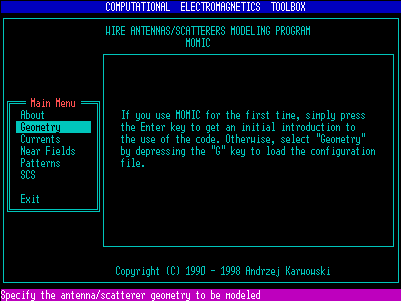
Figure 1. The Main Menu screen of MOMIC
MOMIC is a user-oriented method-of-moments PC program, suitable for analyzing the electromagnetic behaviour of arbitrarily shaped wire antennas and scatterers, modeled by piecewise linear segments, in free space. Capabilities of MOMIC include evaluations of the currents induced/excited on the wires, impedance/admittance parameters, near fields, and far-zone radiation and scattering patterns. With MOMIC one can analyze various antennas and scatterers composed of electrically thin straight and curved wires, and wire-grid models of conducting surfaces. The user interface allows the user to interactively define the geometry of any particular structure, and then to check geometry/configuration data by using a 3D drawing of the structure. Built in graphic output capabilities include 2D linear and polar plots.
Both the calculating
engine and the user interface of MOMIC are written in a highly powerful Lahey
FORTRAN. The target platform for MOMIC executable is an 80486 (or Pentium)
running under MS DOS in 32-bit protected mode. Embedded in MOMIC is the
run-time
version of the Lahey/Phar Lap 386|DOS-Extender which turns DOS in a 32-bit
environment and breaks the DOS 640K barrier. As a protected-mode application
program, MOMIC - looking like any other DOS application - can directly access
all physical memory present in the machine, including memory above 1 MB
(potentially up to four gigabytes). The program can also be run under a
Microsoft Windows DOS compatibility box taking potential advantages of
virtual-memory services provided by Windows. In other words, MOMIC running
under
Windows can have a memory space larger than the available physical memory of
the
computer. However, this mode of execution is generally not
recommended,
since intensive paging/swaping causes significant program performance
degradation. Therefore, MOMIC itself has not been equipped with the virtual
memory option.
MOMIC can be used for the design and analysis of arbitrarily shaped thin-wire radiating and scattering structures (antennas and scatterers), modeled by piecewise linear wire segments, in free space. A typical MOMIC model may involve straight and/or curved wires in arbitrary orientation, wires with different radii, and configurations with multiple wire junctions. For antenna radiation problems, the program solves for the currents on the wires, driving-point admittances/impedances, near electric and magnetic fields, and far-field patterns. Multi-point excitation of the structure is allowed, i.e. the wires can be driven at several arbitrary points along their lengths. Currents and input admittances/impedances at feed points can be observed in arbitrary user-specified frequency range. For scattering problems, MOMIC solves for the currents induced/excited on the wires by a plane electromagnetic wave incident from an arbitrary direction, and then computes bistatic and monostatic (backscatter) scattering cross-sections. Again, options include calculation of the wire currents in the frequency range specified by the user.
The computational algorithms of MOMIC are based upon the integral equation formulation combined with the well-known matrix method (method of moments) suggested by Harrington [1]. Within this general approach the so-called mixed-potential electric field integral equation [2], [3] for the induced/excited current is chosen as a basis for the numerical model of an arbitrary thin-wire structure. The integral equation is converted into a matrix equation via the method of moments with the use of subsectional basis and testing functions [1], [4], [5], [6]. The method involves the three basic steps as follows:
The particular approach used in MOMIC, employing piecewise constant (pulse)
functions for both expansion and testing, generally follows that reported in
[2] with the modifications necessary to make the formulation
applicable to an arbitrary wire structure. An overlapping segment scheme is
employed to enforce Kirchhoff's current law at junctions of two or more wires.
The matrix approximant to the integral equation is solved for the current using
LU factorization approach. Once the current is known, the electric and magnetic
near fields, far-zone quantities or any other electromagnetic quantity of
engineering interest may be readily determined. The formulation employed in
MOMIC is essentially similar to that of MININEC [7], and is highly amenable to
numerical implementation, even when applied to multiple-wire structures with
junctions.
MOMIC system requirements are as follows:
The user interface to the calculating engine of MOMIC is mainly through a
system of dialog text windows (boxes). The windows can not be moved or
resized,
and the excess information scrolls off the windows. The interface is written
in
Lahey FORTRAN and is based on the procedures from the Lahey Spindrift Library.
The graphics auxiliary of MOMIC employs the procedures from the Lahey Graphoria
Library. The interface is rather poor, and its development has been suspended
a
couple of years ago.
The screen diplaying the program Main Menu window with seven available
choices/options is shown in Fig. 1. The menu routines support use of the
cursor Arrow keys moving the highlight bar up or down through the menu choices.
Each option has a single-line help message text associated with it. This
message text, appearing at the bottom line of the screen, conveys relatively
clearly the purpose of the option currently designated by the highlight bar.
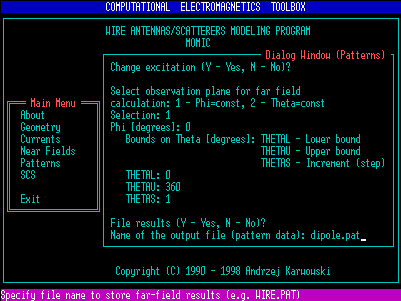
Choosing particular option activates the dialog box/window associated with the
option. For example, Figure 2 shows the screen shot displaying the Patterns
dialog window.
The principal output products of MOMIC are user-designated disk files. The
files
are formatted sequential ASCII and may be easily inspected by using any
appriopriate text editor. The format is convenient for plotting/contouring
programs. Some results can also be displayed in graphic form within the
program.
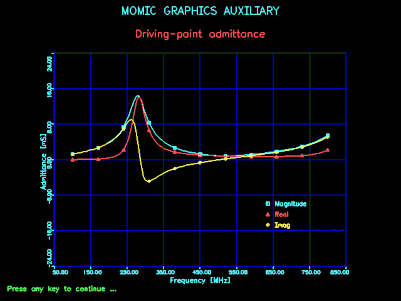
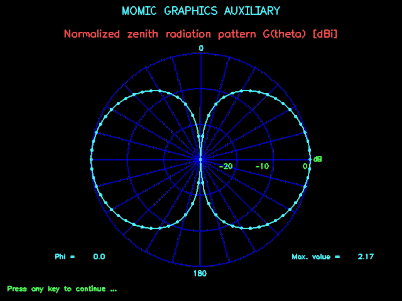
For example, in Fig. 3. are shown the computed results for the driving-point
admittance of a half-meter long symmetric dipole antenna in the frequency range
from 100 MHz to 800 MHz. The far-field radiation pattern of the antenna at 300
MHz is shown in Fig. 4.
The MOMIC main site is on the Web server at the Institute of Electronics,
Silesian Technical University, Gliwice, Poland. The MOMIC mirror site is
the EMLIB site at the Jet Propulsion Laboratory, Pasadena,
California, USA. The code is available from both these sites freely for
non-commercial usage. The software is provided "as is" without express or
implied warranty of any kind.
[1] R. F. Harrington, Field Computation by
Moment Methods, MacMillan, 1968.
[2] A. W. Glisson, D. R. Wilton, "Simple and
Efficient Numerical Methods for Problems of Electromagnetic
Radiation and Scattering from Surfaces", IEEE Transactions
on Antennas and Propagation, vol. AP-28, pp. 593-603, 1980.
[3] K. A. Michalski, "The Mixed-Potential Electric
Field Integral Equation for Objects in Layered Media", Arch.
Elek. Ubertragungstech., vol. 39(5), pp. 317-322, 1985.
[4] R. Mittra (ed.), Numerical and Asymptotic
Techniques in Electromagnetics, Springer-Verlag, 1975.
[5] E. K. Miller, L. Medgyesi-Mitschang, E. H. Newman
(eds.), Computational Electromagnetics: Frequency-Domain Method of
Moments, IEEE Press, 1992.
[6] C. M. Butler, D. R. Wilton, A. W. Glisson,
Fundamentals of Numerical Solution Methods in
Electromagnetics, Short Course Notes, Dept. of El. Eng., Univ.
of Miss., University, Miss., 1984.
[7] J. W. Rockway, J. C. Logan, D. W. S. Tam, S. T. Li,
The MININEC System: Microcomputer Analysis of Wire Antennas, Artech House,
1988.